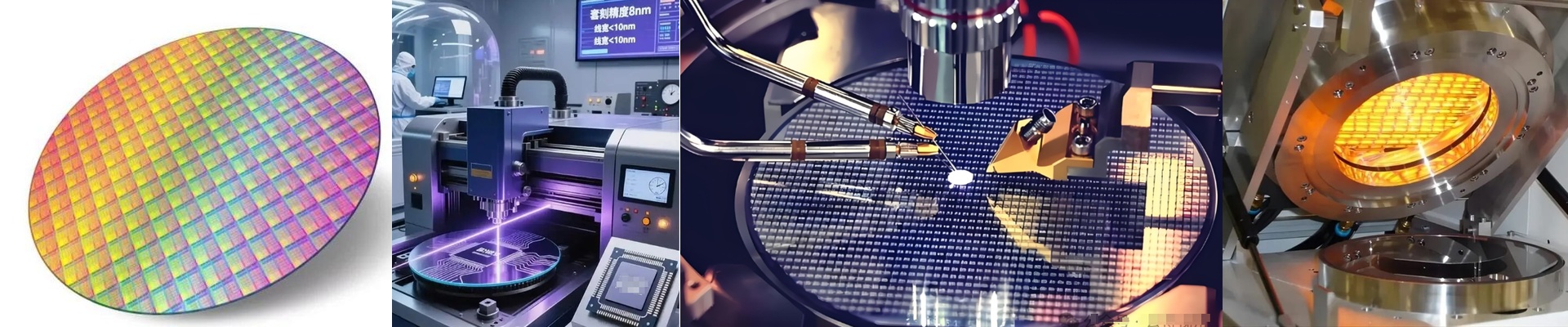
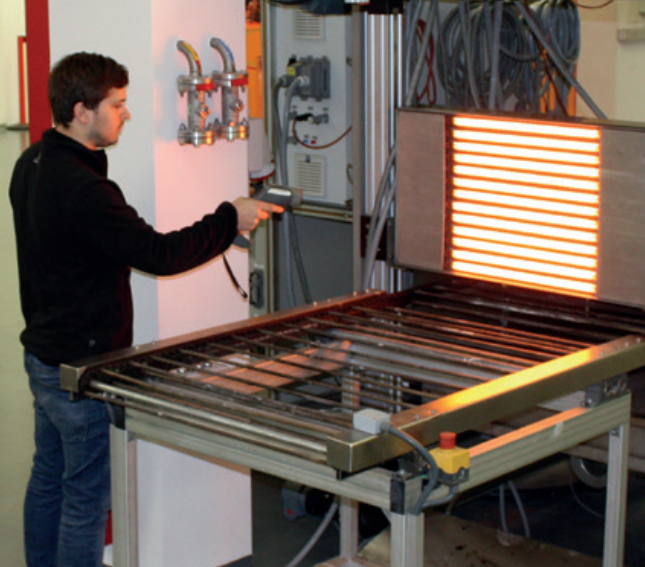
On the lithography floor, the oven light comes on, the bell lifts, and you wait for the wafer to hit the setpoint. Not “close.” The setpoint. Every run. A soft bake that drifts changes resist viscosity and standing-wave behavior. A hard bake that’s not uniform leaves edge residues, shifts reflection notch depth, and turns CD control into a daily fight. When thermal uniformity is off, you stop trusting the tool. You start chasing excursions instead of running the process window. Medium wave infrared heaters were built for that constraint: repeatable temperature delivery with sub-millimeter spatial control of the heat field.
What matters, technically
Medium wave IR lands in a practical sweet spot for wafer heating. The wavelength couples efficiently into common backside films and substrates, and the response is fast enough to close the loop in seconds, not minutes. That speed keeps the thermal budget tight. You control the bake—not the other way around. The core claim is thermal uniformity with sub-millimeter spatial control. In practice, the heater is engineered so the hot zone maps to the wafer geometry with minimal edge roll-off and minimal hot spots. You get a planar thermal profile, not something you have to “fix” by moving the wafer or tweaking setpoints. Repeatability is the other half. In semiconductor, 3:00 a.m. has to match 3:00 p.m. That means stable emissivity, stable lamp output, and a control loop that doesn’t drift. We design for tight distribution across lamps and across cycles because photoresist bake is a fixed recipe step. If temperature varies, critical dimension varies. That’s why the system is closed-loop, not open-loop “set and hope.” You define the bake recipe—soft bake, hard bake, descum, or post-application bake—and the heater holds the setpoint with tight tolerance across the wafer. The payoff is predictable film thickness, predictable profile, and predictable line width behavior.
Why this works in the fab
In wafer fabrication, the bake step is where a lot of yield loss quietly starts. Photoresist processing hinges on solvent evaporation and polymer crosslinking, both highly temperature-sensitive. A nonuniform bake creates thickness gradients and changes the effective absorption profile across the wafer. In lithography, that shows up as CD nonuniformity, local focus shifts, and more sensitivity to underlying topography. With medium wave IR, you get faster ramp-up and faster stabilization. That shortens the bake cycle without giving up control. Shorter bakes mean higher throughput and lower energy per wafer. More importantly, they cut the time the wafer spends in thermal transients, which improves consistency lot to lot. The heater also fits cleanroom reality. It’s built for low particle generation and works in cleanroom classes from Class 1 to Class 100. In practice, you don’t have to choose between thermal performance and contamination control. It’s also built for 24/7 fab operation. The design runs continuous duty, with predictable maintenance intervals and straightforward lamp replacement. When uptime matters, the system needs to start, run, and finish without surprises. The results show up where it counts:
- Tighter bake-to-bake repeatability reduces lot-to-lot bias.
- Better uniformity cuts edge exclusions and rework.
- Faster stabilization boosts throughput without increasing thermal stress.
- Lower energy per bake brings down operating cost, especially at scale.
What you need to know up front
Medium wave IR heaters perform, but they aren’t plug-and-play in every bay without planning. Installation depends on the tool envelope. Match the heater footprint to the process chamber, align the optical path, and make sure the mounting doesn’t introduce mechanical stress that turns into thermal asymmetry. The control interface has to integrate cleanly with the host recipe system so setpoints, ramps, and soaks execute the same way every run. Compatibility also depends on the substrate stack. Backside films, reflective layers, and thin-film stacks change absorption and local temperature response. If you run multiple product splits, you may need to tune the zone map or adjust the closed-loop strategy to keep uniformity in spec across the mix. One real constraint is thermal coupling to the chamber. The heater can respond quickly, but chamber mass and exhaust conditions still impose some lag. Plan to tune the ramp profile once, then lock it into the recipe. And plan preventive maintenance. Lamps age. Reflectors degrade. Keep spares on hand and stick to the recommended replacement interval. That’s how you hold sub-millimeter uniformity and repeatability over years, not just the first week. If you want predictable photoresist bake, stable CD behavior, and fewer thermal-related excursions, medium wave infrared heating gets you there without making the process more complicated.